

If Publishing Is So Tough, Why Keep Writing?
Why do we keep doing this to ourselves?

Today’s post is an updated version of one I wrote about two years ago, but it seems the perfect moment to share these thoughts again. My recent post about being in the query trenches as a published author got a lot of attention — so much that I’m planning a follow up with all the things I’ve learned since from fellow authors. (Keep your eye out for that one - it’s juicy!)
But one big question has emerged in the responses: why do we keep writing – and trying to get published – when the industry is so difficult for authors? In other words, if the chances of our work ever gracing the shelves of a bookstore are so slim, what’s the point?
I’ve certainly had dark nights of the soul when I’ve asked myself the same question, but I also know the real benefits of writing don’t lie in the ephemeral, elusive moments of publication success. We do this for much deeper reasons.
I posed the question to the Inkwell community during a recent Coffee & Co-writing call. The answers were fascinating and varied, from escapism and self-expression to gaining a sense of purpose and enjoying writerly community. Everyone agreed we write because we love it. But love won’t get our books into bookshops.

First, let’s clear something up. I’m talking here about writing that’s intended for publication. Because writing for writing’s sake is quite different from writing with the hope and expectation that your work will be read. Writing as a creative act has value in and of itself. Consider the diaries and journals that people have written for centuries, with no intention of sharing them with the world. Think of arts therapy and the countless people who’ve found relief and healing by expressing their thoughts and feelings on paper. Consider the letters, prayers and love poems that were never meant for eyes other than the recipient’s. Writing for ourselves or our loved ones has a special kind of worth.
This is not that. This is about writing with the dream so many of us have: to write a book and get it published. To see our work on the shelves of bookshops. To be a published author.
The triumph of hope
The simple answer, I think, is hope. We hope we’ll write a book good enough to make it. We hope we’ll find the right people to shepherd it into the world. We hope it will sell lots of copies and readers will love it and we’ll win all the prizes and make millions and we’ll finally be validated and never be sad again. Even though we know this is nonsense, there is still a small part inside us where some part of that hope lives on. And the thing is, it does happen. Dreams do come true. I’ve experienced it and I’ve seen it happen to others.
But even if we do get to experience such things, those glorious moments are fleeting. The bigger, more important answer is why we write in the first place.
Finding your why
Finding your personal why is crucial. Understanding what writing gives you, and using that as your guiding light over time, is what brings long-term fulfilment and sustainability in your writing life.
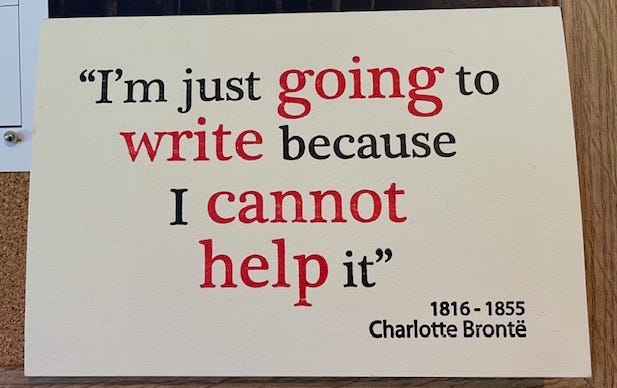
I’m reminded of the famous Charlotte Brontë quote, which sits on a postcard next to my desk: ‘I’m just going to write because I cannot help it’. Unlike Charlotte, I find I can ‘help it’, so over the years I’ve practiced noticing the difference between when I’m writing and when I’m not.
I’m generally happier when I’m working on something, regardless of my publication status. When I’m not, it’s as if there’s background noise – a white noise that I’m not even aware of – until I do write, and it quietens down. Something is not quite right, something I can’t put my finger on. An itch that must be scratched. I know I’m most content when I’ve had a good writing day. When I have a project underway and I’m making progress I’m happier, less irritable and nicer to be around. And that impacts my life and relationships in myriad ways.
Writing gives me other things too, important things. Purpose and direction, an escape, a way to inhabit experiences different from mine, a creative outlet, and a way to communicate. It provides connection: to a community of writers and readers, and to a centuries-long practice of storytelling which is fundamental to our collective human experience. Don’t underestimate this.
And you don’t have to take my word for it. The growing field of neuroaesthetics, or neauroarts, studies the impact that consuming and making art has on our brains and bodies. It turns out that making any type of art is good for us, something Susan Magsamen and Ivy Ross explore in their book, Your Brain on Art: How the Arts Transform Us. They bring together a host of research that proves how essential consuming and making art is to our wellbeing. For instance, a 2016 study conducted at Drexel University discovered that ‘making art for as little as 45 minutes reduces the stress hormone cortisol, no matter your skill level or experience. Making art is physiologically calming.’

Literature is no exception. It’s been proven in studies using fMRI imaging that reading poetry lights up the areas of the brain associated with rewards, and that expressive writing, so often used in therapeutic environments, changes neural activity by accessing areas of the brain that are critical in processing negative emotions. It looks like science is finally confirming things that art therapists have known for decades.
Dozens of studies by James Pennebaker, a social psychologist and pioneer of writing therapy, have shown that expressive writing can ‘reduce blood pressure, lower cortisol levels, lessen pain, improve immune function, and alleviate depression while also heightening self-awareness, improving relationships and increasing our ability to cope with challenges.’
It can even slow down the aging process! Just last week, a study by researchers at UCL concluded ‘that arts and cultural engagement is linked to a slower pace of biological ageing.’
It it literally good for us.
A life-long practice
For me, true fulfilment comes from doing the work. From embracing the process with all its ups and downs, and protecting my relationship with my writing by keeping it separate from the business of publishing.
There’s also joy and meaning to be found in striving to be a better writer. I used to think, I just want to be the best writer I can be. Then I realised that I will never get there. I can always be better. I can always improve. It’s a never-ending pursuit. So now my aim is to be the best writer I can be right now. There is something freeing in realising that this journey doesn’t have a final destination, except the one we are all destined for.
Why we need to be read
There is a caveat. Even if we write primarily for these worthy reasons, we still need to be read. We still need an audience. Storytelling is one of our oldest, cross-cultural traditions. Creating and telling a story is an offering to the world, and we do get something back. We get to be seen, heard and understood. We get to make a contribution. Perhaps we get approval or acceptance. Ultimately, we get connection. All of these are honest human needs, all the more important in these distracted, fragmented times. Most art is made to communicate something, to be received, so we shouldn’t feel embarrassed or ashamed if we passionately want that too. Why we chase traditional publication as our vehicle is a subject for another time.

Don’t get me wrong, publication is fantastic. There’s nothing more gratifying after years of work than seeing your book out in the world and hearing from readers who love what you do. It can bring important confidence-building moments of validation, achievement and genuine elation – a great review, a prize, a moving email from a new fan – all these things should be celebrated, but they are ultimately fleeting. What remains is the work, and your relationship with it. That's where we find true, long-lasting fulfilment.
Try this. Set a timer for at least 5 minutes. Take a pen and paper and free write on this question: What does writing add to my life?
You might be surprised by what comes up.
We talk a lot about the difficulties of writing, the things that get in the way, the struggles and emotions; we don't talk so much about the good stuff because it’s so hard to quantify. It’s individual and intensely personal.
So, why do you keep writing? Only you can answer that question.

P.S. Need some support to make big progress on your writing by the end of the year?
I’m opening my books for 1-1 coaching clients to start June/July. Two spots available! See what other writers say about working with me or book a chat to see if what I do is right for you.
‘I’ve made more progress with my novel over the last three months than I did in the previous 18!’ – Stephanie Griffin

I feel like it's important to remember that whatever the ups and downs, it will always be just me in a room with my laptop. That's the essential thing and it never changes. So it's really all about my relationship to the work. Obviously I still want all the goodies! But there are parts of myself I can only access when writing, and that makes it worth doing.
Great post.
For me, often, writing is the only thing I can control in my life (it feels!) Obviously, I can't control what happens after a project is complete, but that is another story...
Completing a sentence, a paragraph, a chapter, the complete novel, I get the same sense of satisfaction. Only me/we, the writer(s) can accomplish those goals. No one else. We are completely reliant on ourselves. There is a lot to be said for that!